

Best Website Builders 2026
Creating a website no longer requires coding skills or hiring a developer. In 2026, website builders make it possible to choose a template, add your content, connect a domain, and publish a professional website in a matter of hours.
But with dozens of platforms available, choosing the right one can be surprisingly difficult. Some are designed for beginners and small businesses, others focus on beautiful design, ecommerce, blogging, or advanced customization.
In this guide, we compare some of the best website builders in 2026 and explain what each platform is best suited for.
Here are our top picks:
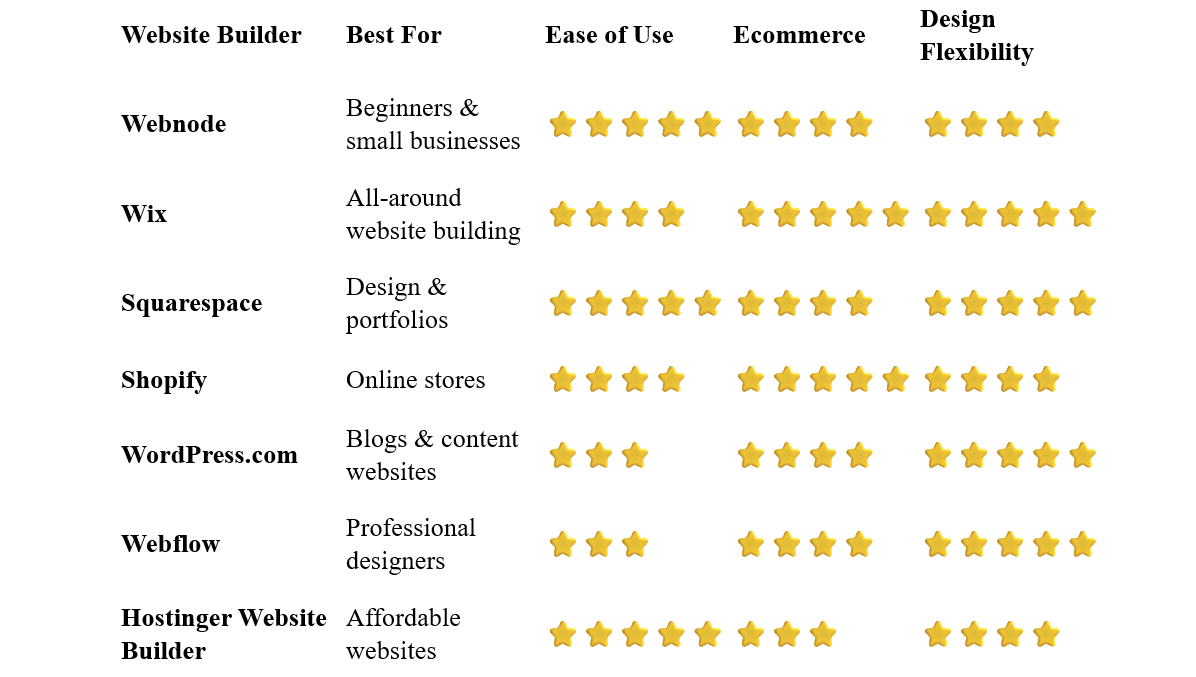
There isn't one perfect website builder for everyone. The best choice depends on what you want to build, how much control you need, and how comfortable you are with technology.
1. Webnode – Best for Beginners and Small Businesses
Webnode is one of the easiest ways to create a professional website without coding. Its guided approach makes it particularly suitable for beginners, freelancers, local businesses, and anyone who wants to get online without dealing with unnecessary technical complexity.
Webnode provides professionally designed templates, an intuitive editor, blogging tools, SEO features, multilingual functionality, and ecommerce options. You can start with a free website and upgrade when you need additional features or your own domain.
Why choose Webnode?
- Very easy to use
- Professional templates
- Hosting included
- Free plan available
- Suitable for business websites
- Multilingual website options
- Ecommerce functionality
- No coding required
Webnode is particularly attractive if your priority is simplicity. You can create and manage a professional website without spending weeks learning how the platform works.
Best for: Small businesses, freelancers, personal websites, portfolios, and beginners.
2. Wix – Best All-Around Website Builder
Wix is one of the most popular website builders available and remains a strong all-around choice in 2026. It combines a large selection of templates with a flexible visual editor and a wide range of built-in features.
Wix is suitable for everything from a simple personal website to a business website or online store. Its AI-powered tools can also help users get started more quickly.
The main advantage of Wix is flexibility. You have considerably more control over page layouts and design elements than with simpler website builders.
Why choose Wix?
- Large template selection
- Powerful drag-and-drop editor
- AI website-building tools
- Extensive business features
- Ecommerce support
- Blogging and SEO tools
- Large app ecosystem
The downside is that having more options can also make Wix feel more complicated to beginners.
Best for: Small businesses, entrepreneurs, freelancers, and users who want extensive design flexibility.
3. Squarespace – Best for Beautiful Websites
Squarespace has built a strong reputation for attractive templates and polished designs. It is especially popular with photographers, designers, artists, consultants, restaurants, and other creative professionals.
Squarespace combines an easy-to-use editor with professionally designed templates and integrated business tools. It can also handle ecommerce, blogging, portfolios, and appointment-based businesses.
Why choose Squarespace?
- Excellent visual design
- High-quality templates
- Easy website editor
- Blogging tools
- Ecommerce functionality
- Marketing features
- Suitable for portfolios
Squarespace is a particularly good choice if the appearance of your website is one of your highest priorities.
Best for: Creatives, portfolios, photographers, designers, and visually focused businesses.
4. Shopify – Best for Online Stores
Shopify is different from many traditional website builders because ecommerce is at the center of the platform.
If your main goal is to sell products online, Shopify is one of the strongest choices available. It provides tools for managing products, inventory, payments, orders, shipping, marketing, and customer accounts.
Shopify also has a huge ecosystem of themes and third-party apps, allowing store owners to expand their websites as their businesses grow.
Why choose Shopify?
- Designed specifically for ecommerce
- Excellent product and inventory management
- Payment and checkout tools
- Large app ecosystem
- Multiple sales channels
- Suitable for growing online stores
For a simple business website, Shopify may provide more ecommerce functionality than you need. But if selling products is the primary purpose of your website, it is difficult to ignore.
Best for: Online stores, ecommerce businesses, retailers, and brands selling physical or digital products.
5. WordPress.com – Best for Blogs and Content-Rich Websites
WordPress.com is a hosted version of the WordPress platform and is particularly well suited to publishing large amounts of content.
WordPress has an enormous ecosystem of themes and plugins, although the level of customization and available functionality depends on the plan you choose.
For bloggers, publishers, content creators, and websites that expect to grow into large content libraries, WordPress remains a powerful option.
Why choose WordPress.com?
- Excellent publishing tools
- Large ecosystem
- Extensive customization
- Strong blogging functionality
- Suitable for content-heavy websites
- Ecommerce options available
The trade-off is that WordPress generally requires more learning than beginner-focused website builders.
Best for: Bloggers, publishers, content creators, and large content websites.
6. Webflow – Best for Advanced Design Control
Webflow is aimed more at professional designers and users who want detailed control over how their websites look and behave.
Unlike simpler drag-and-drop builders, Webflow gives designers much greater control over layouts, responsive behavior, animations, CMS content, and other aspects of a website.
That flexibility comes with a steeper learning curve.
Why choose Webflow?
- Advanced visual design controls
- Responsive design tools
- CMS functionality
- Professional animations
- Strong design flexibility
- Suitable for sophisticated marketing websites
Webflow is probably unnecessary if you simply need a five-page business website. But for designers and agencies who want more control, it can be an excellent choice.
Best for: Professional designers, agencies, startups, and users who need advanced visual control.
7. Hostinger Website Builder – Best for Affordable Websites
Hostinger combines website building with hosting and focuses heavily on affordability and simplicity.
Its AI-powered tools can help generate website content and layouts, while the visual editor allows beginners to make changes without coding.
Hostinger is worth considering if keeping initial costs low is particularly important.
Why choose Hostinger Website Builder?
- Affordable plans
- Beginner-friendly editor
- AI website-building tools
- Hosting included
- Templates for different industries
- Ecommerce functionality on supported plans
It may not offer the same depth as some of the larger platforms, but it can be a practical solution for a straightforward website.
Best for: Beginners, personal websites, freelancers, and budget-conscious users.
How to Choose the Best Website Builder
The best website builder isn't necessarily the one with the most features. It's the one that gives you the features you actually need without making website management unnecessarily complicated.
Consider these questions before choosing a platform:
What type of website are you building?
A small business website has very different requirements from an online store.
For a simple business website, Webnode, Wix, or Squarespace may be more than enough. If you want to build a serious ecommerce business, Shopify deserves a closer look.
How important is ease of use?
If you have never created a website before, look for a platform with an intuitive editor, good templates, and minimal technical requirements.
Webnode and Wix are particularly beginner-friendly choices, while Webflow and WordPress generally require more time to learn.
Do you need an online store?
If you're selling products, make sure the platform provides the ecommerce functionality you need.
Shopify is built around ecommerce, while Wix, Webnode, Squarespace, and WordPress can also support online stores.
How much design freedom do you need?
Some people want to choose a template, change the text and images, and publish. Others want complete control over every part of the design.
If simplicity is more important, Webnode or Squarespace may be a better fit. If extensive customization matters, Wix or Webflow may be more appropriate.
What will your website need in the future?
Don't only think about what you need today.
A simple website may eventually need a blog, online store, booking system, multilingual content, email marketing, or other functionality. Choose a platform that can grow with your project.
Website Builders vs. WordPress
One of the most common questions is whether to use a website builder or WordPress.
Traditional WordPress gives you a huge amount of flexibility, but you are generally responsible for more technical decisions, including hosting, updates, themes, plugins, security, and maintenance.
Website builders take a different approach. Hosting and many technical components are integrated into the service, allowing you to concentrate primarily on creating and managing your website.
For beginners and small businesses, that simplicity can be a major advantage.
Are Free Website Builders Worth It?
Free plans can be useful when you want to experiment with a platform before paying for it. However, they usually come with important limitations.
A free plan may give you:
- A platform subdomain instead of your own domain
- Limited storage or features
- Platform branding or advertisements
- Restricted ecommerce functionality
- Fewer customization options
For a serious business website, a paid plan with your own domain usually provides a much more professional result.
Which Website Builder Is Best in 2026?
There is no universal winner, but the platforms above cover most common needs.
Choose Webnode if you want a simple, professional website that you can build and manage without technical expertise.
Choose Wix if you want an all-around platform with extensive design freedom and a large selection of features.
Choose Squarespace if beautiful design and presentation are your highest priorities.
Choose Shopify if your main goal is building an online store.
Choose WordPress.com if publishing and content are at the heart of your website.
Choose Webflow if you need advanced design control and are willing to spend more time learning the platform.
Choose Hostinger Website Builder if you want an affordable and straightforward way to get online.
Final Thoughts
The website builder market in 2026 offers excellent options for almost every type of website. You don't need to be a developer to establish a professional online presence.
For most beginners, the most important factors are ease of use, templates, essential features, pricing, and the ability to expand your website later.
If you want to get a professional website online quickly and prefer a simple, guided experience, Webnode is one of the strongest options to consider. If you need more advanced design freedom, Wix may be a better fit. For ecommerce, Shopify is the obvious specialist choice.
The best approach is to identify what your website actually needs first and then choose the platform that meets those requirements without adding unnecessary complexity.
⭐ Popular Guides ⭐
Ready to start building your website? Explore our popular guides to compare website builders and find the right solution for your needs, experience, and budget.


